Are you in Copenhagen on Thursday? (Or are you any close to Copenhagen? In that case: make sure to get there!) Because you wouldn't want to miss a lecture by a world-renowned NT-scholar, right?
On Thursday November 19th, Dale B. Martin will lecture on "The Meaning of PORNEIA in Hellenistic Judaism and Early Christianity, including Paul", criticizing the thesis by Kyle Harper. (Which can be found here: ‘Porneia: The Making of a Christian Sexual Norm’, Journal of Biblical Literature 131 no. 2 (2012) 363-383.)
Time and place: 14.15-16.00, Aud. 8, second floor.
Showing posts with label Copenhagen University. Show all posts
Showing posts with label Copenhagen University. Show all posts
Tuesday, 17 November 2015

Sunday, 22 February 2015
Is the RRE Blog still alive?
Yes, it is. It was just in a state of hibernation, which really isn't that strange if you think about Scandinavian winters.
But we're back with great news: another student graduating from the program!
About two weeks ago, Ivana from Serbia handed in her thesis. Me and Thomas visited her on her last full day in Copenhagen. In between catching up over a good cup of coffee and eating Asian food at Wagamama (we recommend), she showed us det Kongelige Bibliotek - Copenhagen's very new Royal Library, which is also known as the Black Diamond.
It's a great building with fantastic architecture and a majestic atmosphere. We were highly impressed. Go to Copenhagen, ye prospective RREs. :-)


Ivana, congratulations!
/PD
But we're back with great news: another student graduating from the program!
About two weeks ago, Ivana from Serbia handed in her thesis. Me and Thomas visited her on her last full day in Copenhagen. In between catching up over a good cup of coffee and eating Asian food at Wagamama (we recommend), she showed us det Kongelige Bibliotek - Copenhagen's very new Royal Library, which is also known as the Black Diamond.
It's a great building with fantastic architecture and a majestic atmosphere. We were highly impressed. Go to Copenhagen, ye prospective RREs. :-)
 |
| Ivana and her thesis in front of the room where she spent many hours writing |
 |
| Some images of the library, but they don't really do justice to the building. |
 |
| By Ivana's request, I had to include a picture with all of us on it. Allright then. |
/PD
Friday, 22 August 2014
Denmark calling with course information
Hej alle, har i haft en god sommer?
Soon we'll upload a welcoming message for the new student, but right now we have some good news coming from the theological faculty in København, which could be interesting for both new and old student!
Firstly, Martin Ehrensvärd, coordinator in Denmark, would like to pass on the following message:
"You see, I’m giving a course in Classical Syriac this fall. Syriac is an Aramaic dialect and thus relatively closely related to Hebrew and Arabic. A vast amount of early Christian literature is written in Syriac. The course will start from scratch but will proceed quickly as it presupposes that students have earlier experience with one or more Semitic languages. There will be one Skype-based lesson pr week."
An AULA-page for the course should by now have been created and I assume that the course will head off in the week of September 1st. Who's up for the challenge?`
Moreover, Martin also asked Thomas Hoffmann, professor in Copenhagen, about his upcoming course "The Qur'an and the Bible", which is an interaction course. See here the nice Youtube clip that they made!
/PD
Soon we'll upload a welcoming message for the new student, but right now we have some good news coming from the theological faculty in København, which could be interesting for both new and old student!
Firstly, Martin Ehrensvärd, coordinator in Denmark, would like to pass on the following message:
"You see, I’m giving a course in Classical Syriac this fall. Syriac is an Aramaic dialect and thus relatively closely related to Hebrew and Arabic. A vast amount of early Christian literature is written in Syriac. The course will start from scratch but will proceed quickly as it presupposes that students have earlier experience with one or more Semitic languages. There will be one Skype-based lesson pr week."
An AULA-page for the course should by now have been created and I assume that the course will head off in the week of September 1st. Who's up for the challenge?`
Moreover, Martin also asked Thomas Hoffmann, professor in Copenhagen, about his upcoming course "The Qur'an and the Bible", which is an interaction course. See here the nice Youtube clip that they made!
/PD
Wednesday, 30 October 2013
Three Lundanean students on their way to the compact seminar
 |
| What does an RRE student do on a Wednesday morning? Packing for the Compact seminar... |
 |
| Taking the train from Lund Station... |
 |
| Crossing the bridge... |
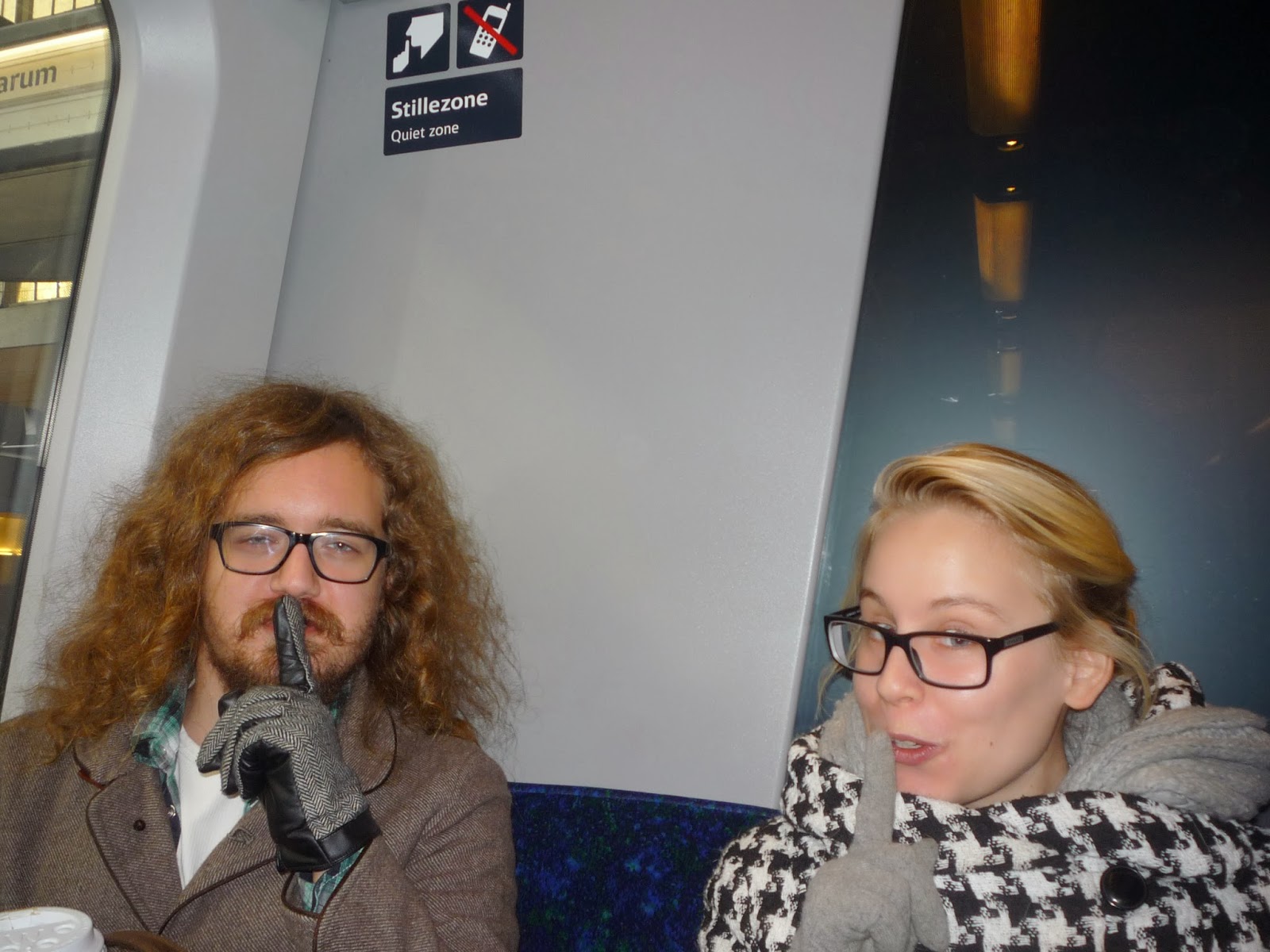 |
| Ending up in the silent coupe in the S-Tog to Nörreport... |
 |
| Almost there... |
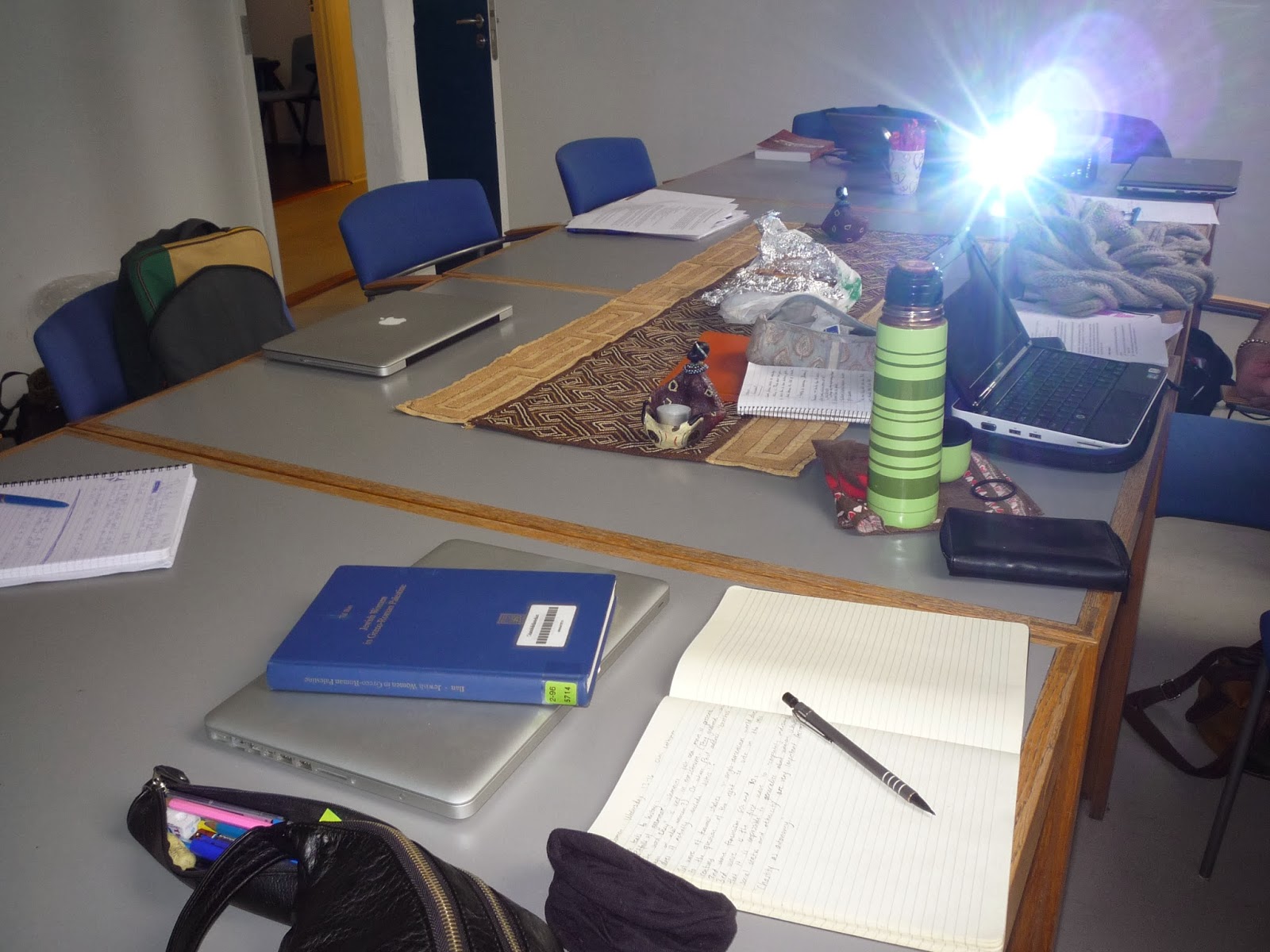 |
| We made it! |
Monday, 28 October 2013
Copenhagen here we come!
While a heavy
storm from Great Brittain is heading towards the Öresund area, all fifth cycle RRE students are currently
making their way to Copenhagen for the first Compact Seminar of this term!
Stay safe during the storm!
/PD
For readers who wonder what that means: twice a semester
students from all the six host universities get together at one of the
institutions to get some real-life lectures next to all the distance learning
and the local tutorials. Needless to say that this is not only an intellectual,
but also a social peak for us RRE-ers. (I.e. I think four out of five nights dinner parties have already been planned.)
From Monday afternoon to Wednesday morning, the
fifth cycle will have classes in their compulsory course ‘Emergence of the
Three Religions’. On Wednesday afternoon, most fourth cycle students will arrive
too and four elective courses (Women in the Three Religions, Philosophy and Wisdom
Traditions, Quran (Arabic text course) and Early Christian Martyrdom (Latin
text course)) will head off until Friday afternoon.
I will make the trip to Köpenhamn (less than
one hour over the bridge from Lund) on Wednesday morning and I can’t wait to
catch up with many friends! Hopefully, I’ll manage to give an update of how things are going later during the week. Stay safe during the storm!
/PD
Wednesday, 30 May 2012
"My research" - a new, monthly column in the RREblog
My research- by Martin Ehrensvärd, Copenhagen University
I've been asked to write a few words about my research. Well, my early
research was on the incredibly interesting nuances in the use of the
definite article in Hebrew, compared to a bunch of other languages. Then I
moved on to investigating the fascinating syntax of negated infinitives in
Biblical Hebrew, but neither of these subjects is what I will write about
here - for I ended up looking at how syntax, and language in general, might
be used as tool for dating biblical texts.
This turned out to be a controversial topic, especially since I landed
right in the middle of the 'minimalist-maximalist debate'. To put it
crudely, the debate is about whether to date the biblical literature
earlier - in which case it is more likely to contain correct historical
information - or later, in which case it is more justified to read it
primarily as literature/ theological narrative rather than historical
narrative.
Anyways, what I ended up arguing was that language, as opposed to what the
received wisdom said, didn't seem to be able to serve in the dating of
biblical texts, because we simply do not know enough about biblical Hebrew
to talk with any kind of precision about linguistic dating. The consequence
of this potentially is that the maximalist/ conservative argument is
weakened, since some of the strength of the maximalist hypothesis is
dependent on linguistic dating.
This has led to a fierce debate spanning the last decade. The debate
doesn't seem likely to end anytime soon. For a statement about my views,
you can read a co-authored statement found here:
http://www.bibleinterp.com/articles/yount357913.shtml
For an example of criticism, see
http://www.bibleinterp.com/opeds/hen358022.shtml
- and here is the attempt at a rebuttal of the criticism:
http://www.bibleinterp.com/articles/rez358028.shtml
Note how the discussion continues in the comments section below the
articles.
I've been asked to write a few words about my research. Well, my early
research was on the incredibly interesting nuances in the use of the
definite article in Hebrew, compared to a bunch of other languages. Then I
moved on to investigating the fascinating syntax of negated infinitives in
Biblical Hebrew, but neither of these subjects is what I will write about
here - for I ended up looking at how syntax, and language in general, might
be used as tool for dating biblical texts.
This turned out to be a controversial topic, especially since I landed
right in the middle of the 'minimalist-maximalist debate'. To put it
crudely, the debate is about whether to date the biblical literature
earlier - in which case it is more likely to contain correct historical
information - or later, in which case it is more justified to read it
primarily as literature/ theological narrative rather than historical
narrative.
Anyways, what I ended up arguing was that language, as opposed to what the
received wisdom said, didn't seem to be able to serve in the dating of
biblical texts, because we simply do not know enough about biblical Hebrew
to talk with any kind of precision about linguistic dating. The consequence
of this potentially is that the maximalist/ conservative argument is
weakened, since some of the strength of the maximalist hypothesis is
dependent on linguistic dating.
This has led to a fierce debate spanning the last decade. The debate
doesn't seem likely to end anytime soon. For a statement about my views,
you can read a co-authored statement found here:
http://www.bibleinterp.com/articles/yount357913.shtml
For an example of criticism, see
http://www.bibleinterp.com/opeds/hen358022.shtml
- and here is the attempt at a rebuttal of the criticism:
http://www.bibleinterp.com/articles/rez358028.shtml
Note how the discussion continues in the comments section below the
articles.
Friday, 17 February 2012
The Everyday Life of a Religious Roots Student!
We have had quite a lot of posts about applying and the new great one asking for the professors candid opinions! But for you lot out there who are thinking about the course, I thought I would give you an exclusive look into the day to day aspects of a hardworking (?!) student's life!
So at the moment, like the rest of Copenhagen students we have just finished a number of exams. I would say the average person has to complete 2 or 3 exam papers during this period, which isn't bad! They can either be fixed or free exams, depending on how many assignments you have completed during the semester. (I will get to this thrilling discussion post haste!) With a fixed exam the lecturer must set you a question based on a reading list you have selected and you have four days to complete. On the other hand, the free exam leaves you far more time for the almost compulsory exam procrastinations (see other entries on helpful procrastination tips from an expert procrastinator).
Unfortunately, there is no rest for the wicked after exam period as we choose our new modules and start reading for these. Each module differs but usually, we have weekly assignments where we post a 300 (or there abouts) written piece about the reading and our interpretations. We are then asked to comment on other peoples' pieces with a seemingly mandatory "well done, but" or "good job, however" as we then go in for the kill and disagree in good old fashioned debate style! This year, I myself have chosen, what I feel are some great modules: Latin (which I have always wanted to study, being a Classics geek!), and two 'interaction' modules entitled 'The role of women in religious communities and texts' and 'Ancient philosophy and the making of theology in early Christianity'. Both modules offer different and interesting reading material and discussions, with plenty of primary sources. So far, and in all honesty, I have thoroughly enjoyed both of them.
I am not going to lie and say that the workload is easy, because it isn't. Like a full time job, you have to dedicate hours to a lot of reading and participating in discussions. However, what we are discussing is interesting and if you through yourself in and get involved then there is so much to gain from it and others. The real great thing about this programme is the mixture of people on it, and when you open up discussions about topics such as philosophy and gender studies, the opinions vary dramatically. I feel that I have as much to learn from my colleagues as I do the secondary sources I read.
Another daily duty for me other than work hard, is to play hard! I am an international student studying in Copenhagen and there is plenty to do! If I'm not catching up on the gossip over coffee, its the cinema, a great independent restaurant, or even a sneaky drink! I always feel that you have to balance your time, all work is not healthy and when there's so much fun to be had, why not have it! I believe that us 'Religious Rooters' share this mentality; we are often found in the Student House gossiping together and try and organise regular events where we can just catch up!
Anyways, I think thats about it! See ya!
Wednesday, 15 February 2012
Five question to the professor- week 7
As mentioned in an earlier blogpost, we decided on doing some interviews with professors and other staff connected with the RREprogram. First one out is Martin Ehrensvärd, from Copenhagen University.
1. Please state your name,age, university and connection to the RREprogram.
Martin Ehrensvärd, 44, University of Copenhagen. I'm the local coordinator which means that I'm the one with most contact with the students, trying to make sure that everything runs smoothly. I also lecture in the programme.
2. What is your area of expertise? and which courses do you teach in the RREprogram?
I'm a Semitic philologist by training and have mostly published in the area of language, mostly classical Hebrew but also Arabic. I teach classical Hebrew and classical Arabic, and in addition I lecture in mysticism and some early mystics.
3. How do you find the this way of teaching, which is not regular university courses but also not distance learning?
I love it! I teach via Skype, and I love the flexibility of it - being able to teach students resident all over Scandinavia. Also, the teaching can go on undisturbed even if they or I am travelling. On a side note, the students in the programme tend to be bright, and this adds tremendously to the joy of teaching.
4. What do you expect from your students?
I expect that they sign up to the courses out of a genuine motivation to learn - and that they expect to be able to spend seven or eight hours pr. week, including classes. I also expect and encourage them to cooperate with me so that we together can create the best possible learning environment. When everybody state what they think without holding back, it is much easier to go forward together.
5. If you could have any superhuman power, what would it be and why?
Very interesting question. Ok, well, my greatest wish for every human being, including myself, is that we become more curious about what it actually is like to be in other peoples' shoes. In other words, the empathetic urge to set one's own agenda aside for a moment and genuinely sense into what is going on 'over there', be it in another person (like a relative or colleague) or a group of people. So, I would choose the power to plant the idea in everybody's heart that it might be a good idea to start genuinely finding out what it is like to be in someone else's shoes, especially the people one is in conflict with. And why? Because I think this would make the world a vastly better place to live for everyone.
Wednesday, 8 February 2012
Copenhagen info
Thursday the 9.of February (tommorow) at 12:15 in room 243 at the theological faculty in Copenhagen, there will take place an infomeeting for students curious about studying RRE. if you yourself are interested, or you know somebody who might be, this is an important date to remember.
we will try to post info here at the blog about stuff happening related to RRE in the different universities, and if you would like to email or meet with one of us students, please write an email to: religiousroots@gmail.com and we will be happy to help you :)
we will try to post info here at the blog about stuff happening related to RRE in the different universities, and if you would like to email or meet with one of us students, please write an email to: religiousroots@gmail.com and we will be happy to help you :)
Friday, 9 December 2011
About the Faculty of Theology in Copenhagen


High Class Research
The Faculty of Theology at the University of Copenhagen ranks highly internationally for the quality of its research. Particularly in the fields of the Old Testament/ Hebrew Bible (the Copenhagen school), the Dead Sea Scrolls, the New Testament in its Graeco-Roman context (including philosophy) and feminist Biblical studies, the Faculty is internationally recognized for its expertise.
The Faculty has broad contacts with researchers worldwide, not least through its participation in The International Alliance of Research Universities (IARU).
What are the Admission Requirements?
At least six students will be admitted to the programme at the University of Copenhagen in 2012.
The selection of students is based on the fulfillment of the following admission requirements:
a) A Bachelor's degree in a field of study that is relevant to the programme (e.g., theology, religious studies, classical philology, Semitic languages, ancient history etc.). The applicant must have, or anticipate getting, a Bachelor's degree from a recognized and internationally acknowledged university.
b) Documented proficiency in at least one "classical" language (i.e., 20 ECTS in either Hebrew, Greek, Latin or Arabic; or 10 ECTS in two "classical" languages)
c) Documented proficiency in English:
Level B for Danish students with a Danish bachelor's degree
TOEFL paper-based test score of at least 600
TOEFL internet-based test score of at least 83
TOEFL computer-based test score of at least 250
IELTS test score of at least 6.0
d) The selection of students is furthermore based on the relevance of the Bachelor's degree in terms of field of study, as well as on the grades achieved, and on the number of courses and ECTS-points that students have gained in relevant study areas (e.g., theology, religion, ancient history, culture and language).
Tuition fees
There are no tuition fees for students from Denmark and EU/EES countries (EU and Iceland, Liechtenstein and Norway). For students from non-EU/EES countries the tuition fee is in the order of DKK 60.000 per year.
When and how to apply?
Application deadline is 1 March.
The Application must include:
a) A Bachelor's degree Certificate (the degree certificate may be forwarded after the closing of the application period, but it must arrive at the faculty of Theology at the University of Copenhagen by August 1 at the latest).
b) Documentation for proficiency in at least one "classical" language (i.e., 20 ECTS in either Hebrew, Greek, Latin og Arabic; or 10 ECTS in two "classical" languages)
c) Documentation for proficiency in English.
d) CV and a letter of motivation.
The application must include all the required documents. Incomplete or late applications cannot be processed. The application with all the required enclosures must be mailed via regular (air) mail or by an international courier service to The Faculty of Theology. E-mailed or faxed applications or documents will not be accepted.
The address is:
Faculty of Theology
University of Copenhagen
Købmagergade 44-46
DK- 1150 Copenhagen K
ATT: International Coordinator
For further information, see http://www.teol.ku.dk/english/religious_roots/
or contact coordinator Martin Ehrensvärd, meh [att] teol.ku.dk
Subscribe to:
Posts (Atom)